Keeping technology simple wins in the long run
I recently worked with two clients who demonstrated something I had long suspected: rigorous discipline in keeping technology simple is a huge advantage in the long term.
On the surface the two companies were very similar:
- Both were commercially successful technology businesses
- Both were ready for the next stage: selling all or part of their businesses
- Both were about the same age
- Both had software of a similar age and type
- Both had some obvious needs for modernisation of some of their technology
I provide a tech deep-dive service to help businesses with product and technology prioritisation and planning when they reach a key inflection point (like succession or exit). I had the opportunity to sit down with the founders, tech leaders, and engineers at both businesses and look at their product and technology in detail.
YAGNI
I’ll call the first business Client A. It quickly became clear that Client A had embraced “you ain’t going to need it” (YAGNI). When I asked about potential obstacles to upgrading as-yet no upgraded key tech the answer was that there were no known obstacles: it just didn’t need to be upgraded yet. If I asked how far through an architectural change was, the answer was 100% through. Client A had decided there was no point in starting something new until the current job was finished. While there was some need for modernisation, the approach of only changing what needed to be changed, and always finishing what was started had created a clear path forward to modernise. This made establishing a feasible technology roadmap, estimating costs and building a hiring plan straightforward for me to do.
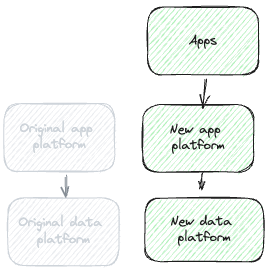
Client A: keeping it simple
Layer upon layer
Client B was in a different situation. Deep diving on technology is a bit like archeology: I dig down through the layers, unearthing clues and evidence that paint a picture of how people worked in the past and why things are now the way they are. Client B had a lot of layers. Over time, many new technologies and approaches had been introduced. It is likely that continuing with existing technology and making incremental change would have also been an option, but was rarely the option taken. Unfortunately, each time something new was introduced, it was often only applied to part of the suite of products. This left behind significant duplication of business logic and tangling of concerns, making ongoing development complex and error prone. To establish a roadmap for modernisation would take a lengthy period of remediation.
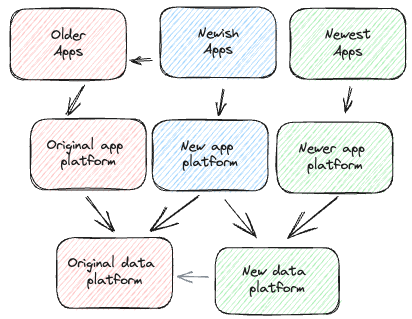
Client B: complex
Simplicity wins
By only adopting new technology when it was needed and finishing what was started, Client A had positioned themselves as an attractive target for acquisition at a fair price. Client B was fixable, but it had a long and expensive road ahead before a worthwhile exit could be achieved!
Are you thinking about change in your business and are wondering what shape your technology is in? I can help! Read more at cronin.nz or drop me a line at gareth@cronin.nz.